

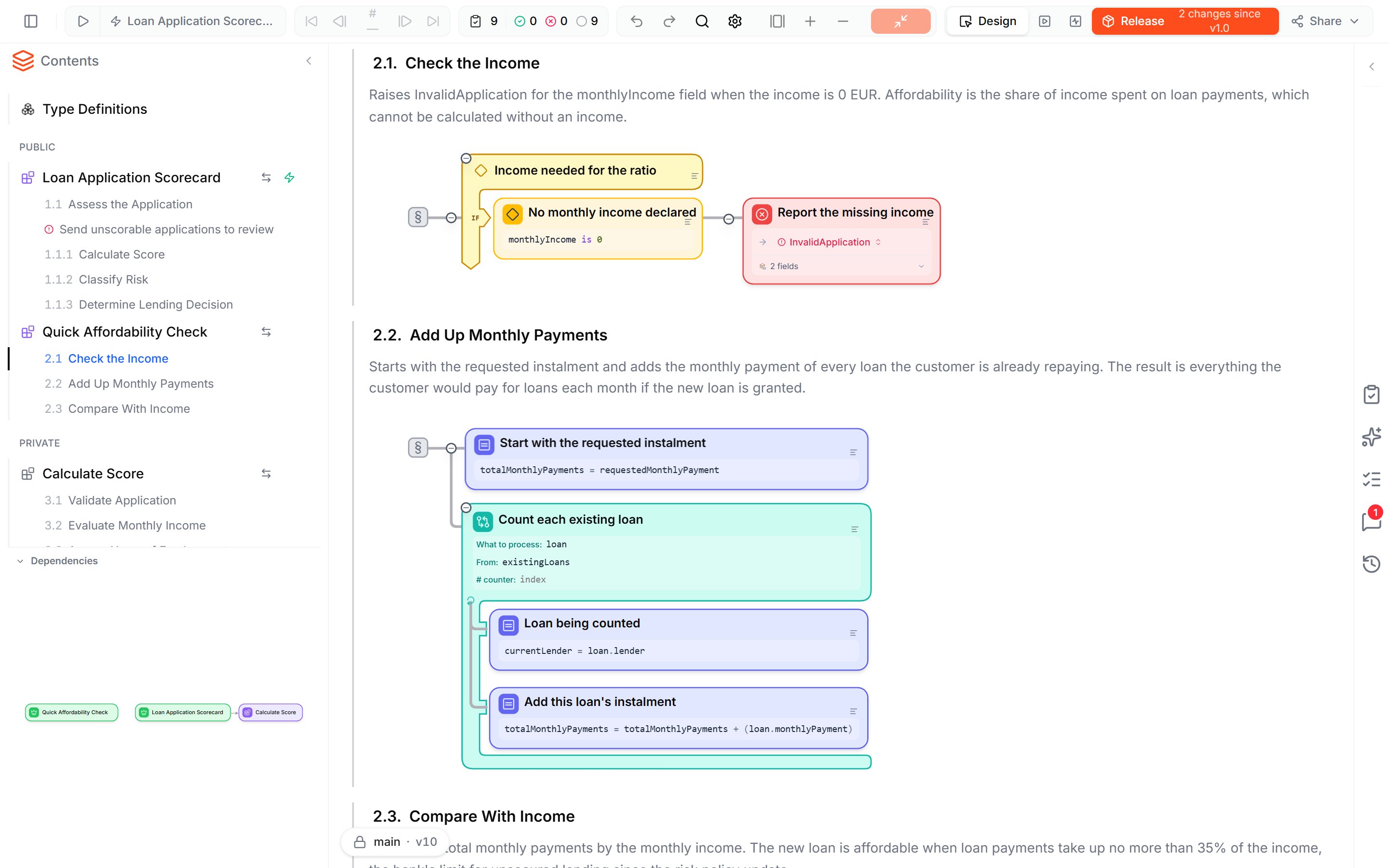
Each section of a Blueprint pairs a plain-language description with its executable diagram.
The problem with probabilistic logic
When multi-step business logic is executed by a probabilistic model, even a small per-step error rate (drift across steps) quickly compounds into an unacceptable failure rate. When the outcome truly matters (billing, compliance, risk, pricing), “close enough” is not acceptable. This is an architectural problem, not a prompting problem: you are relying on a probabilistic tool to do a deterministic job. It forces teams to babysit AI automations with human review, which prevents them from safely scaling into production.What Leapter gives you
Leapter reverses the control. Instead of asking an agent to invent the logic each time, you define it once as a visual, executable Blueprint, and it runs the same way every time.Who it’s for
- Heads of Compliance & Risk: auditable decisions that come out the same every time.
- Domain experts: own and approve the rules in plain language, without code.
- CIOs & Heads of AI: put agentic automation into production safely.
- Engineering leaders: stop hand-coding and babysitting brittle business logic.